Trauma Scale Guide for Scores, Questionnaires, and Next Steps
Searching for a trauma scale can be confusing because the phrase is used in several different ways. One person may mean a simple trauma scale 1 10 rating. Another may be looking for a trauma scale questionnaire, a PTSD checklist, an ACEs score, or even an emergency medicine score for physical injury. Those tools do not measure the same thing. A psychological trauma scale looks for patterns in experiences, symptoms, beliefs, or stress responses; it is not the same as a brain injury score or a medical triage score. If you want a private first step before speaking with a professional, a private trauma self-reflection tool can help you organize what you are noticing without treating the result as a final answer.
What People Mean by a Trauma Scale
A trauma scale is not one universal ruler. In psychology, it usually means a structured set of questions that helps estimate trauma exposure, trauma-related symptoms, or beliefs that may follow distressing experiences. In everyday language, it can also mean a quick rating of how intense something feels right now. In emergency care, "trauma score scale" may refer to physical injury tools such as the Glasgow Coma Scale or Revised Trauma Score.
That distinction matters. A high number on a psychological trauma scale may suggest that symptoms deserve attention. A low number does not mean your experience was unimportant. A physical trauma score, on the other hand, is about injury severity, consciousness, breathing, blood pressure, or related medical signs. Mixing the two can lead to unnecessary fear or false reassurance.
A 1-10 rating is a snapshot
A trauma scale 1 10 is usually an informal distress rating. It can be useful when you want to track how activated, overwhelmed, numb, or unsettled you feel in the moment. For example, you might rate your distress before and after a grounding exercise, after a difficult conversation, or while preparing notes for therapy.
The strength of a 1-10 rating is simplicity. The limitation is that it depends on your own frame of reference. Your "7" may not equal someone else's "7," and the number may change with sleep, safety, stress, support, and how close you are to a reminder of the event.
A questionnaire looks for patterns
A trauma scale questionnaire asks multiple questions because trauma reactions rarely show up as one feeling. A scale may ask about intrusive memories, avoidance, body tension, sleep, shame, mood changes, relationship strain, dissociation, or beliefs about safety and trust. The score is more structured than a single 1-10 rating, but it still needs context.
Good use of a trauma scale means asking, "What pattern is this showing?" rather than "What label does this give me?" A score can help you notice themes, choose what to track, and decide whether professional support would be useful.
Common Psychological Trauma Scales
Different psychological trauma scales answer different questions. Some focus on PTSD symptoms after a specific event. Others focus on childhood adversity, trauma-related beliefs, dissociation, secondary stress, or the impact of discrimination. The right scale depends on age, purpose, time frame, and whether a trained professional is involved.
The PTSD Checklist for DSM-5, often called the PCL-5, is a common adult self-report measure for PTSD symptoms. It has 20 items and looks at symptom clusters such as re-experiencing, avoidance, changes in mood and thinking, and hyperarousal. A total score can help track symptom severity over time, but interpretation belongs in context.
The Davidson Trauma Scale, or DTS, is an older PTSD symptom measure based on DSM-IV symptoms. It asks about both frequency and severity, which is useful because a symptom that happens often and a symptom that feels intense are related but not identical.
The ACEs scale, or Adverse Childhood Experiences questionnaire, is different. It does not measure current PTSD symptoms. It counts categories of early adversity such as abuse, neglect, or household dysfunction. An ACE score can open a conversation about developmental risk and resilience, but it cannot capture every form of childhood trauma, culture, protection, timing, or healing.
Other scales are more specialized. A childhood trauma scale may focus on maltreatment history. A trauma-related cognitions scale may focus on beliefs about safety, blame, trust, or self-worth. Vicarious trauma and secondary traumatic stress scales are often used with helpers, clinicians, first responders, journalists, advocates, or caregivers who are affected by repeated exposure to others' suffering. Racial trauma scales or discrimination-related symptom measures address harm connected to racism and identity-based stress, but they should be chosen carefully and interpreted with cultural humility.
Psychological Trauma Scale vs Brain or Injury Scores
Search results often mix psychological trauma scales with physical trauma scoring systems. If you see terms such as brain trauma scale, Glasgow trauma scale, Glasgow Coma Scale, trauma score scale, or Revised Trauma Score, you may be looking at emergency medicine rather than mental health screening.
The Glasgow Coma Scale measures level of consciousness after a medical event or injury. It is based on eye, verbal, and motor responses, and the total score runs from 3 to 15. The Revised Trauma Score uses physiologic information such as level of consciousness, blood pressure, and breathing to support injury triage. These are not tools for understanding emotional trauma, PTSD symptoms, childhood adversity, or coping patterns.
This is why the words around the scale matter. If the page discusses emergency departments, coma, respiration, or systolic blood pressure, it is about physical trauma. If it discusses symptoms, memories, avoidance, beliefs, ACEs, or emotional regulation, it is about psychological trauma.
How to Read Trauma Scores Without Overreading Them
The safest way to read a trauma scale assessment is to treat the score as a signal, not a verdict. Scores can point to possible areas of concern, but they do not carry your whole story. A number cannot tell whether you had support afterward, whether the event was repeated, how old you were, whether you felt trapped, or what strengths helped you survive.
For PTSD-focused tools, higher scores generally suggest more frequent or intense symptoms. On the PCL-5, for example, a total score can range from 0 to 80, and research often discusses a cut point in the low 30s as a possible flag for probable PTSD in some settings. That does not mean the number alone gives a final clinical answer. Cut points vary by population and purpose, and a professional may consider the event history, symptom duration, functional impact, safety, substance use, grief, depression, anxiety, physical health, and cultural context.
For ACEs, a higher score is associated with greater population-level risk, but it does not predict one person's future with certainty. Many important experiences are not included in the original ACE categories, and many protective factors are not counted either. For a 1-10 distress rating, the best use is comparison with your own past ratings, not comparison with someone else.
A practical way to read any trauma score is to ask four questions:
- What exactly does this scale measure: exposure, symptoms, beliefs, distress, or physical injury?
- What time frame does it use: today, the past week, the past month, childhood, or lifetime?
- Who is it designed for: adults, children, adolescents, caregivers, clinicians, or a specific population?
- What would a caring next step be if the score feels concerning?
Choosing a Trauma Scale for Adults, Children, and Adolescents
For adults, a trauma scale for adults may be useful when you want to organize symptoms before therapy, track changes over time, or understand whether trauma-related stress may be part of a broader pattern. A brief screening tool can be a starting point, while longer clinical questionnaires are better used with trained support. If you want a low-pressure first look, an anonymous trauma screening starting point can help you reflect before deciding what to discuss with a mental health professional.
For children, scale choice should be more careful. Young children may not have the language to explain fear, shame, intrusive memories, or body reactions. Some tools use caregiver reports, some are completed by clinicians, and some are designed only for certain age ranges. Search terms like "trauma scales for checklist for young children" often point to specialized instruments that should be interpreted by someone who understands child development.
For adolescents, self-report can be helpful, but privacy, trust, consent, and safety matter. Teens may minimize symptoms to avoid attention or overstate distress when they feel unheard. Either response can communicate a need for support. A trauma scale for adolescents should never be used to shame, pressure, or interrogate a young person. It should help adults listen better.
A Gentle Way to Use a Trauma Scale
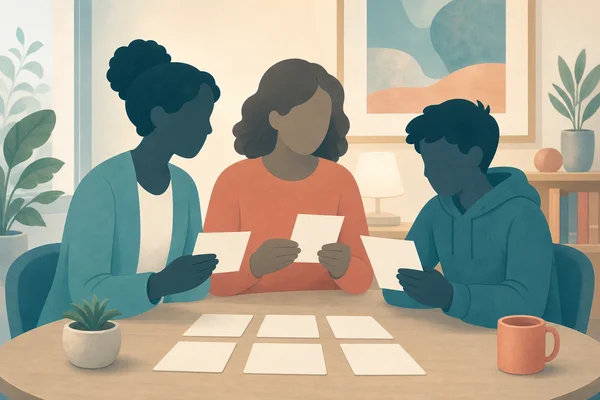
A trauma scale works best when it supports reflection instead of self-judgment. Before you complete a questionnaire or rate your distress, choose a steady moment if possible. Have water nearby, take breaks, and remind yourself that you can stop. If a question feels too activating, that reaction itself may be useful information to bring to a therapist or trusted professional.
After you finish, write down three notes: what felt most familiar, what surprised you, and what kind of support would feel realistic this week. That support might be a therapy consultation, a grounding practice, a conversation with a trusted person, or a review of coping resources. If you are comparing scores over time, look for movement and patterns rather than perfection.
If you use a gentle online trauma check-in, keep the result in its proper place: educational, private, and exploratory. It can help you name concerns and prepare for a more informed conversation, but it should not replace professional care when symptoms are intense, long-lasting, or affecting daily life. If you feel at risk of harming yourself or someone else, seek urgent local help right away.
FAQ
What is the trauma score scale?
"Trauma score scale" can mean different things. In mental health, it may refer to a questionnaire that estimates trauma exposure or trauma-related symptoms. In emergency medicine, it may refer to physical injury tools such as the Glasgow Coma Scale or Revised Trauma Score. Check whether the scale discusses emotions and symptoms or medical signs and injury triage.
What is the scale for measuring trauma?
There is no single scale for measuring all trauma. Common psychological tools include PTSD symptom checklists, ACE questionnaires, childhood trauma measures, trauma-related belief scales, and secondary stress measures. Each tool measures a different part of the picture, so the best choice depends on your question.
What are the 7 major traumas?
There is no universally accepted list of "7 major traumas." People may group trauma by source, such as childhood adversity, interpersonal violence, accidents, medical trauma, loss, discrimination, disaster, combat, or repeated exposure to others' suffering. The impact depends on context, support, timing, duration, and the person's nervous system, not only the category.
What is considered a high PTSD score?
It depends on the tool. On the PCL-5, scores in the low 30s are often discussed as a possible flag for probable PTSD in some settings, but the right cut point can vary. A high score suggests that professional evaluation may be worthwhile; it is not a final clinical answer by itself.
Is a trauma scale test the same as therapy?
No. A trauma scale test or questionnaire can help you organize what you are experiencing, but therapy is an ongoing relationship with a trained professional. A scale can support reflection, screening, and tracking; therapy can help with safety, meaning, coping, and recovery work.
Can a trauma scale be used for children?
Yes, but only with age-appropriate tools and careful interpretation. Young children often need caregiver-report or clinician-supported measures. Adolescents may use self-report tools, but privacy, consent, and emotional safety still matter.
Is a 1-10 trauma scale reliable?
A 1-10 rating can be useful for tracking your own distress over time, especially before and after coping strategies. It is less useful as a universal measure because people define numbers differently. Use it as a personal thermometer, not as proof of how valid your experience is.